
Every week in the south, workers organize new unions, they bargain for new contracts, they fight for good legislation and against bad legislation, and they put the boss in their place. These are some of the stories we could find from July 10th to July 17th: this is Last Week in Southern Labor.
New Campaigns
59 workers in 4 bargaining units have gone public with their union campaigns, and 9 workers in 1 bargaining unit are trying to decertify their union
- 12 workers at Starbucks Corporation in Florence, AL filed a petition to hold a union election with Starbucks Workers United, as did 24 workers at another location in Amarillo, TX
- 4 workers at Amicalola EMC in Jasper, GA filed a petition to hold a union election with the International Brotherhood of Electrical Workers (IBEW) 84
- 19 workers at Dark Horse Electric, LLC in Sunbright, TN filed a petition to hold a union election with the IBEW Local 270
- Workers likely pushed by their employer filed a petition to decertify the Laborers International Union of North America (LiUNA) Local 830 as the union representing 9 workers at Missouri Red Quarries, Inc. in Ironton, MO
Election Results
129 workers in 3 bargaining units withdrew their petitions for a union election, and 30 workers in 3 bargaining units voted in favor of unionization
- 13 workers at Rusk County Electric Cooperative, Inc. in Henderson, TX voted 13 to 0 in favor of unionization with the IBEW Local 738
- 2 workers at Kentucky Power in Ashland, KY voted 2 to 0 in favor of unionization with the IBEW Local 978
- 15 workers at Starbucks Corporation in Falls Church, VA voted 9 to 6 in favor of unionization with Starbucks Workers United
- The NLRB Regional Director closed a decertification petition case – the 3 workers at General Dynamics Information Technology in Panama City, FL will remain represented by the International Association of Machinists and Aerospace Workers (IAMAW) District 75
- 54 workers at Menzies Aviation MCO in Orlando, FL withdrew their petition with the Transport Workers Union of America (TWU)
- 70 workers at Local Cannabis Company in Smithville, MO withdrew their petition with the Teamsters Local 41
- 5 workers at Children’s Hospital t/a Children’s National Hospital in Washington, DC withdrew their petition with the District of Columbia Nurses Association
Grievances, Unfair Labor Practices, Court Cases
- Matt Bruenig has a new piece out on his blog NLRB Edge about the ridiculously large legal footprint of the Starbucks Workers United campaign. To date, the union has organized over 700 stores and over 15,000 workers. This campaign has generated to date 16,077 documents – more than one per organized worker. The public documents (of which there are about 6,400) contain 43.7 million words. There have been 370 legal decisions, including one from the Supreme Court. This obviously makes organizing difficult. Breunig notes that “like everything, law is subject to material constraints. Lawyers are finite. Judges are finite. NLRB attorneys, regional directors, ALJs, and Board members are finite. Animating these various actors costs money and is subject to various bottlenecks that can clog” and that while the stated policy of the United States is to encourage the practice of collective bargaining “when a union can win this many elections at this rate and by these margins, but has to put up with this without securing any collective bargaining agreements, then the system we have is clearly at odds with its stated purpose.”
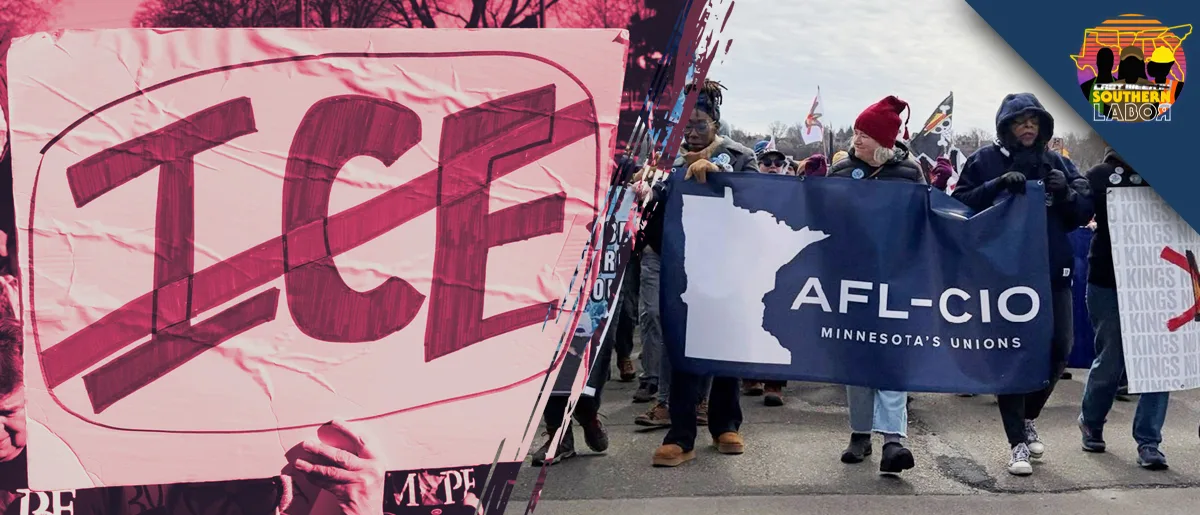
- The AFL-CIO is calling for investigations into the recent ICE killings, and for Congress to pass legislation to rein in the agency
Strikes & Bargaining
- Austin, TX transit workers voted by 99.5% to authorize a strike and the Keolis – the private contractor for Austin’s transit system – exceeded their wage demands. That’s the latest as The Amalgamated Transit Union (ATU) Local 1091 continues negotiations with the company over remaining issues. Among the demands are benefits for a group of workers that work full time but currently get none, better training, more time off, and overtime pay for administrative workers. At the time of the strike vote, the Austin Chronicle said that Brent Payne, President of the union told them that a strike is now “highly likely,” but Keolis may be coming to their sense now. Keolis had been refusing these demands from the workers despite the fact that they secured a huge contract from the government in 2023, and despite the fact that this ¾ a of a billion dollar contract is their largest in the country. The union says an internal survey showed that over 75% of its members can’t afford to live in the city. Transit workers in Austin haven’t been on strike in nearly 20 years – the last time was in 2008.
- The Communications Workers of America (CWA) just reached a tentative agreement for 7,500 passenger service workers nationwide at Piedmont Airlines. The agreement includes raises and a minimum ratification bonus of $500 or 6%, whichever is higher. This comes after they secured a settlement for underpaying workers under the previous agreement
- A former Austin, TX EMS Union leader is raising the alarm about overwork among EMS employees in the city. The Austin Chronicle has an article on the issue, here’s a portion that I think should worry folks: “The Chronicle asked a field medic who had just come off a standard 24-hour shift about the workload. The medic, who wished to remain anonymous, said that in the past responders would have time to sleep for a few hours at night, after calls died down. ‘It’s a lot more common now for people to get calls throughout that entire 24-hour period, to a point where they just really don’t get any sleep,’ he said.”
- Alstom workers on the Atlanta Plane Train just ratified their first collective bargaining agreement. Their union – the Transportation Communications Union (TCU-IAM) – said the agreement continues an 18% raise over 5 years, just cause protections, seniority, more paid time off, and more.
- 25 workers at the Federation of American Scientists (FAS) in Washington, DC just ratified their first collective bargaining agreement after forming the first union in the organization’s 80 year history. FAS voluntarily recognized the union – the International Association of Machinists (IAM) – in 2024. The union says the 2 year agreement contains just cause protections and grievance procedure, annual 3% raises, more paid time off, and more
- LaborNotes has a great play-by-play of the NNU contract fight at UMC in New Orleans
Political & Legislative
- There is no nursing shortage. That’s not coming from the hospitals – that’s coming from National Nurses United (NNU), the largest nursing union in the country. But they’re not saying because they think there are enough nurses on the job – far from it, NNU is a leader in calling out hospitals that don’t have enough nurses on the job, pointing to how that is dangerous for patients and for nurses. Rather, what they’re saying is there are more than enough nurses to do the jobs, but hospital management isn’t doing enough to keep workers. As evidence, they point to the fact that the supply of nurses is growing faster than the population overall, and that there already exists a huge amount of nurses who aren’t working in a nursing job right now – 1.15M nurses who have active nursing licenses but aren’t in the field. So instead of a nursing shortage, NNU says there is a retention crisis. The union says that chronic understaffing by management, low pay, and workplace violence are pushing nurses who want to work away from the profession. NNU President Jamie Brown said that “It’s not uncommon for nurses to experience the never-ending cycle of training a new nurse, only for them to leave after six months because of the intolerable conditions. Then, they have to repeat the process, while still managing a full patient load, until they can’t take it anymore and leave as well. It’s also not uncommon for nurses with less than a year of experience to take on the role of preceptor, or trainer, because experienced nurses are leaving the profession. That’s unacceptable and needs to be solved.” NNU is calling on Congress to pass the Nurse Staffing Standards for Hospital Patient Safety and Quality Care Act, which would enact nationwide nurse to patient minimum staffing ratios
- Unions and veterans groups were able to kill the misnamed “Taking Care of America’s Veterans Act.” You can see previous editions of Last Week in Southern Labor for more on the bill, but TLDR it would’ve degraded working conditions for VA employees, pushed veterans out of the VA system and into the private sector, and more bad things. IFPTE celebrated the its stoppage
Internail Union Affairs
- Through sustained internal and external organizing, AFGE says they are starting to grow again, not just lose members
- Delegates from across the country gathered for the convention of the Brotherhood of Maintenance of Way Employees (BMWE-Teamsters). One resolution I had my eyes on was to implement one member one vote for the BMWE – the Teamsters have it already, and since BMWE is an affiliate of the Teamsters I just assumed that it would go through pretty easily. That wasn’t the case however – Railroad Workers United (RWU), a cross craft caucus of railroad workers – told me that the motion was voted down 2 to 1 at convention. Matt Weaver, a BMWE member and the delegate who seconded the motion, said it became clear pretty quickly during debate which side had the momentum and decided to call the question. He supported the motion because he believes one member one vote improves participation from members and encourages them to take ownership of their union. He said delegates arguing against the motion made arguments that proponents of one member one vote will be familiar with: rank and filers aren’t educated enough about internal union issues to make the right choice, that members can already have their voices heard through delegates, and that it would be too costly. Weaver said that proponents of the motion calculated an election would only cost $0.09/member/month, which he believes is worth it, and that 25% of members were not able to have their voices heard because their locals either didn’t or couldn’t send a delegate. While he described the outcome as “frustrating,” he emphasized that its not the end of the world and that he believes the people running the union are doing good job. “The Brotherhood has taken excellent care of me,” he said during our conversation. In more positive news from the convention, he highlighted the opportunities to communicate and network with folks he normally doesn’t come across. “Carriers like to keep us in our silos so we don’t hear about good grievances and memorandums of agreement,” he said, and conventions like this allow railroaders to share those stories with each other about how to fight back